• I have saved video snippets of the experiment in segments so you can wait for them to download.
• The lab report is below and steps through the process
• References are given for my background research. Some have some interesting stuff so have a look. The Boston University site has time lapse QuickTime movies of bacteria growning.


To see which products that say have they antibacterial properties
actually do.
Materials:
17 x Petri dishes, filter paper, growth medium (agar, but I just
used aeroplane jelly), incubator (or an esky at 37 degrees C),
sterilizer, E. coli (Escherichia coli), Bunsen burner, scissors,
marker, 5 x beakers, wire inoculated loop, Dettol hand wash, Domestos,
Handy Andy, Morning Fresh dishwashing liquid, pure water (sodium
chloride).
Hypothesis:
Not all products that claim to have antibacterial properties will
stop germs growing.
Procedure:
1. put a T mark on the bottom of each Petri dish (divided into
3 parts. Top 3rd covers half of the plate; bottom two covers a
quarter each).
2. prepare growth medium, and put some into each Petri dish.
3. sterilize everything (even the Petri dishes, in a pressure
cooker).
4. put the products into a beaker each, and the E. coli into the
5th.
5. put 4 Petri dishes for each beaker, and 1 for the water, as
the control.
6. name all of the Petri dishes with the name of the product,
and two of the 4 “neat”, 1 “50%” and the last of the 4 “20%”.
7. wait for the growth medium to set
8. dab the wire inoculated loop into the E. coli and “zig zag”
it in each area of the growth medium (re-dab the loop after each
area).
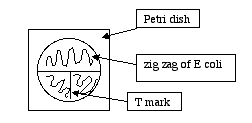
10. cut the filter paper into small squares, about 2cm by 2cm
11. dap a filter paper square into the product and put it in the
middle of the Petri dishes (with the products name on it) with
“neat” on them.
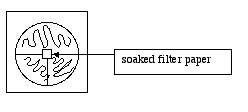
13. put 20% of the product and 80% of sodium chloride on a filter paper square and put in the middle of a Petri dish named with the product you soaked it in and with “20%” on it.
14. put the dishes in the incubator for 12 hours
15. take them out and record results (if no germs are growing around the filter paper, then the product works).
16. destroy the E. coli
Results:
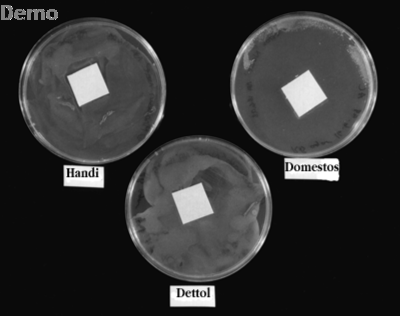
Domestos was the only antibacterial product. There was hardly any growth in the Domestos Petri dishes, but the 20% had a small amount of growth around the filter paper.
Discussion:
Because I didn’t do the experiment in a lab (I did it at home, under less than ideal conditions) it no doubt affected the results. Some variables were most likely an inconsistent temperature in the incubator and the growth medium I used (which was aeroplane jelly).
Conclusion:
In my experiment I set out to prove that not all products that claim to have antibacterial properties actually do, and I believe I proved that right. I was not surprised about the Handy Andy and the Morning Fresh not working, but I was surprised about the Dettol hand wash. Domestos, the only product that worked, is in the same chemical group as chlorine and halogen. As they are very strong, and can even burn the human skin, it was not surprising it worked. If you are interested in microbiology and wish to try this experiment or any other, please have supervision, as germs like E. coli can cause illnesses like food poisoning.
References:
Dugid J.P, Marmion B.P and Swain R.H.A, Medical Microbiology. Volume One: Microbial Infections. 13th Edition. Churchill, Livingstone, London 1978
Principals of Molecular Biotechnology. Laboratory Manual. ID 330. 1998 Department of Biochemistry, Microbiology and Chemical
Engineering, The University of Queensland.
Edwald H.T et al. Micro-Organisms for Education, http://www.science-projects.com/safemicrobes.htm
Boston University Experiments, Fractal Bacterial Colonies, http://qsad.bu.edu/ogaf/bact/bact1.html.